Antique Crock Value
Price data updated June 2026 from recent eBay sold listings.
Antique Crocks Value Chart (2026)
| Type | Typical sold range | Median | Sales |
|---|---|---|---|
| Antique Stoneware Crock | $27–$125 | $50 | 70 |
| Antique 5 Gallon Crock | $74–$160 | $126 | 43 |
| Antique Stoneware Jug | $30–$135 | $53 | 78 |
Typical range = middle 50% of recent eBay sold listings (single items, lots excluded). Exceptional examples exceed it; rough ones fall below.
Beyond the typical: decorated stoneware
The chart above is for plain, undecorated salt-glazed and Bristol-glazed stoneware — the everyday baseline. Cobalt decoration changes everything. These figures are cited from Crocker Farm, the leading American stoneware auction house (realized prices, including buyer's premium), not from our eBay sold sample:
| Type | Typical sold | Why / source |
|---|---|---|
| Cobalt bird / animal decorated | $400–$5,000+ | A single cobalt bird or animal from a named Northeastern pottery multiplies value far past a plain crock. [Crocker Farm] |
| Elaborate decorated scenes | $3,000–$100,000+ | Ambitious hand-painted scenes (deer, game birds, pecking chickens) are the trophy tier — a Stetzenmeyer deer crock realized $108,000. [Antiques & The Arts] |
Maker matters too: documented early potters (Commeraw, Crolius) and signed Edgefield pieces (David Drake) bring five figures regardless of decoration. If your crock has cobalt artwork, an incised maker's mark, or crisp decoration, the main chart doesn't apply — have it looked at by a stoneware specialist. Condition (cracks, chips) is the biggest swing factor on every tier.
Antique Crock Value Estimator
Loading the estimator…
How Much Are Antique Crocks Worth?
Most antique stoneware crocks are worth less than people expect. Based on recent eBay sold listings, the typical salt-glazed or Bristol-glazed crock changes hands between $35 and $130, with a median around $55. Plain, unmarked, and undecorated crocks cluster at the low end of that range — they were utilitarian kitchen and dairy ware made by the millions, and supply still far outstrips demand.
Size and capacity move the needle. Larger pieces marketed as 5-gallon crocks sell for more, with a median near $159 and a top quartile reaching $430 — partly because big crocks are scarcer and harder to ship, and partly because the most desirable decorated examples tend to be the larger sizes. Antique stoneware jugs land in the same neighborhood as ordinary crocks, with a median around $60.
The exceptional sales — like a stamped Red Wing salt-glaze leaf crock that brought over $1,000 — are not the norm. Those are maker-marked, cobalt-decorated, regionally collected pieces, and they are the exception that proves the rule: condition, decoration, and a known pottery are what separate a $40 crock from a four-figure one.
Antique Crock Identification Guide
%2C_probably_made_in_Maryland%2C_with_cobalt_blue_decoration._A_variety_of_stoneware_jars%2C_churns_(0b13f4ca-416b-4fe7-b6b9-524909ccb71c).JPG)
NPS / Public domain — click for source

Minnesota Historical Society / CC BY-SA 2.5 — click for source

Wikimedia Commons / CC0 — click for source

Annie B. Johnston / CC0 — click for source
See more: museum & archive photos on Wikimedia Commons · hundreds of recent sold examples on eBay (with prices — the single best way to match yours).
What Makes an Antique Crock Valuable?
- Cobalt decoration. Hand-painted cobalt blue designs — birds, flowers, leaves, deer, or elaborate scenes — are the single biggest value driver. A plain crock might bring $40 while the same form with a well-executed cobalt bird or flower brings several hundred. Crude brushed numbers or simple swags add little.
- Maker's mark / pottery. Named makers carry premiums. Red Wing, and impressed marks from known Northeastern and Midwestern potteries pull above the median. Common 20th-century makers like Western Stoneware (Monmouth), Ransbottom, and Uhl sell solidly but rarely break $100 unless decorated.
- Capacity and size. Bigger generally means more money — 5-gallon and up sell well above small 1- and 2-gallon crocks. But oversized 10- and 20-gallon pieces are also harder to ship and easier to crack, which caps demand among online buyers.
- Condition. Hairline cracks, chips, freezer breaks, and flaking glaze cut value sharply. Collectors want a crock that 'rings like a bell' when tapped. A perfect crock can be worth several times a cracked example of the same form.
- Advertising and place names. Crocks and jugs stamped with a merchant, distillery, or town name — especially regional whiskey and liquor advertising — draw local collectors and can far exceed plain examples.
- Original lid. Matching original lids are frequently lost. A crock with its correct lid is worth a clear premium, and lids alone sell as replacement parts.
Valuable Antique Crock Types & Maker's Marks
- Red Wing stoneware. The most collected American maker. Marked salt-glaze and zinc-glaze pieces, wing logos, and decorated leaf/petal patterns command top dollar; an exceptional stamped salt-glaze leaf crock in this data sold for over $1,000.
- Decorated salt-glaze (Northeastern). 19th-century cobalt-decorated crocks and jugs from New York, New England, and Pennsylvania potteries are the blue-chip end. Incised or slip-trailed birds, animals, and named towns bring strong premiums.
- Western Stoneware / Monmouth & Ransbottom. Common early-20th-century Midwestern utilitarian ware. Maple leaf and crown marks. Reliable sellers but mostly under $100 unless large or unusual.
- Whiskey and advertising jugs. Stoneware jugs with distillery, saloon, or merchant advertising — especially scratch/incised lettering and Kentucky whiskey names — outperform plain brown-top jugs and draw breweriana collectors.
- Uhl Pottery. Indiana-made stoneware with the acorn mark. A collectible name; jugs and crocks sell steadily in the mid-range and higher for marked, clean examples.
Antique Crock Sold Prices: Recent eBay Sales
A representative slice of the actual transactions behind the table above — lowest to highest. Each links to the original listing.
-
 $17
$17 -
 $25
$25 -
 $30
$30 -
 $40
$40 -
 $54
$54 -
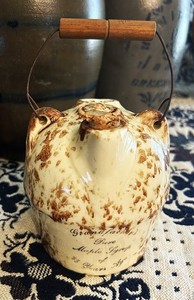 $80
$80 -
 $149
$149 -
 $449
$449
Selling Your Antique Crock: What You'll Actually Net
Crocks are heavy, fragile, and awkward — shipping is the biggest practical obstacle. A 5-gallon crock can cost $25–$45 to ship safely double-boxed, and breakage claims are common, so build that into your price expectations. For ordinary pieces selling under $100, local sale (Facebook Marketplace, antique malls, farm and estate auctions) often nets you more than eBay once fees and shipping risk are factored in. eBay makes sense for marked, decorated, or advertising pieces where you need national collector reach.
On eBay, expect roughly 13% in fees plus shipping. Photograph the bottom, any marks, and every chip or hairline honestly — collectors will return or dispute misrepresented condition. Tap the crock and note in the listing if it 'rings' (a sign it's crack-free); buyers look for that phrase.
The Most Valuable Antique Crocks
The realistic top tier in this category is 19th-century salt-glazed stoneware with elaborate cobalt decoration — large birds, animals, or pictorial scenes — from documented Northeastern potteries, along with rare marked Red Wing pieces. The best decorated examples sell at specialist auctions (such as Crocker Farm) well into the thousands and occasionally tens of thousands. Within this dataset, the standout was a stamped Red Wing salt-glaze leaf crock at $1,150; that is exceptional, not typical, and it took a known maker plus desirable form to get there.
Verified record sales (cited — these are the documented exceptions, not expectations):
- Dave Drake 25-gallon poem jar (enslaved potter David Drake, Edgefield SC) — $1,560,000, Crocker Farm. The American pottery auction record — nearly double the previous record. [Antiques and The Arts Weekly]
More category records on our most valuable antiques page.